Travel to Ireland
Day 13 Portumna, Clonfert, Clonacmoise (284 Km.)
(in 74 Km.) Portumna: We stopped at Portumna where stands out the Portumna Castle, a semi-fortified house built in the early 17th century in the Renaissance style already prevalent in Italy and France for over a century, but not commonly found in Ireland or England at that time. The Renaissance features of the exterior are the doorcase of the front entrance and the Tuscan gateway of the innermost courtyard. Also within the Portumna Forest Park are the remains of a Cistercian abbey (Portumna priory), dating from the 15th Century and adjacent to the Park is a marina giving access to the Shannon waterway system.

Portumna Castle
(in 24 Km.) Clonfert: The current building of the Clonfert Cathedral was erected in the 12th century. The earliest part of the church dates back to around 1180. Its doorway is the crowning achievement of Hiberno-Romanesque style. It has a large variety of motifs, animal heads, foliage, human heads etc. The early 13th century east windows in the chancel is an example of a late Romanesque windows. The chancel arch was inserted in the 15th century, and is decorated with angels, a rosette and a mermaid carrying a mirror. The supporting arches of the tower at the west end of the church are also decorated with 15th century heads. The sacristy is also 15th century.

Clonfert cathedral
(in 32 Km.) Clonacmoise: Clonmacnoise is an abbey and a paleo-Christian monastic ensemble located on the banks of the Shannon River. Its name in Irish Gaelic is Cluain Mhic Nóis ("Meadow of the Sons of Nós"). Clonmacnoise was founded by St. Ciarán in 545 AD. C. The saint had a vision and sought for years the right place for the future location of the abbey. Finally, along with eight companions, he found the place and also Diarmait (or Diarmuid) Mac Cerbaill, who helped him build the first building, a small wooden church. Diarmait would become 565 in the first Great King of Christian Ireland. The Finghín Temple is a 12th-century Romanesque church with an Irish circular tower 17 m high. In 1135 lightning struck the top of the tower, which was rebuilt later. It is believed that the masonry demolished by the storm was later used in the construction of the Finghín Temple.
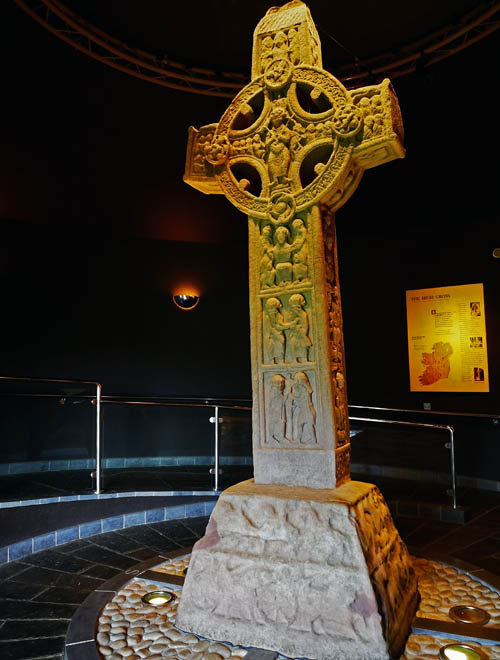
Clonacmoise - High Cross
The Temple Connor dates from the 11th century and was used by the Church of Ireland until the 18th century. It is currently a Protestant church and is kept closed to the public. Other churches on the site are the Temple Kelly, the Temple Melaghlin (1200), the Temple Dowling (11th century), the Temple Hurpan (the most recent, 17th century) and the Temple Ciarán. The latter is the smallest church in Clonmacnoise (measuring only 2.8 x 3, 8 m) and the tradition states that it contains the tomb of St. Ciarán. On the contrary, the so-called Clonmacnoise Cathedral is the largest of the churches of the place. It was built in 909 by Flann Sinna, King of Ireland, and Abbot Colman. The west entrance is a later addition of 1180, as well as the north entrance, dating from the mid-fifteenth century and is Gothic in style.
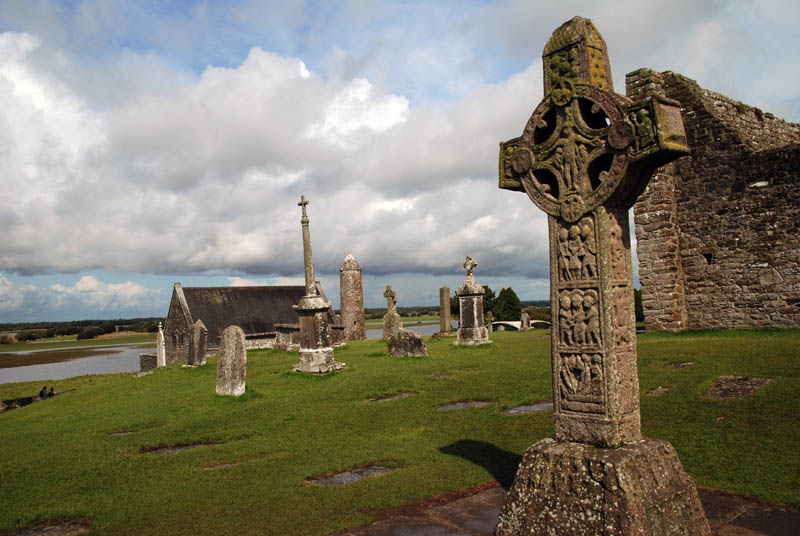
Clonacmoise
In Clonmacnoise there are also two Celtic crosses, called Southern Cross (ornamental) and Cross of the Scriptures. The Cross of the Scriptures is 4 meters high and was carved from a single block of sandstone around the year 900. It is one of the most beautifully worked Celtic crosses in Ireland and has a special interest in its inscriptions, which constitute a prayer dedicated to the makers of the cross (and the Cathedral), Flann and Colmán. The surface of the cross is divided into panels, showing scenes that include the Crucifixion, the Last Judgment and Christ in the Tomb. An oldest third extant cross is the North Cross, created c.800. Only the limestone shaft and sandstone base (a former millstone) survive. We can see the original crosses in the museum and the replicas in their original place.
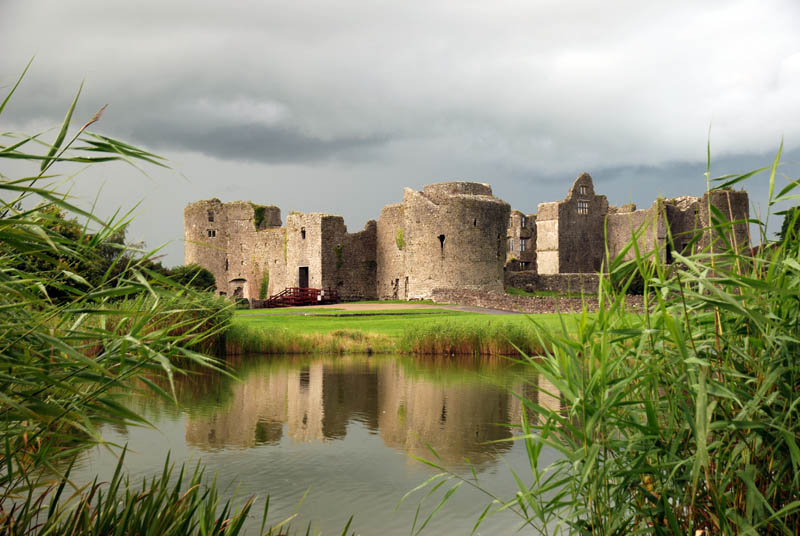
Roscommon castle
(in 56 Km.) Roscommon castle: Roscommon Castle is located on a hillside just outside the town. Now in ruins, the castle is quadrangular in shape, it had four corner D-shaped towers, three storeys high, and twin towers at its entrance gateway, one of which still retains its immensely sturdy vaulted roof. The entire castle was enclosed by a lofty curtain wall. It was built in 1269 by Robert de Ufford, Justiciar of Ireland, on lands he had seized from the Augustinian Priory. A symmetrical moat some distance from the curtain walls surrounded the entire castle and safeguarded it. It is now a national monument.
(in 98 Km.) Ballina: We will sleep at Bed and breakfast Lisduvogue House.